
BlogRoute Optimization
Route OptimizationHow to Organize Deliveries with Multiple Drivers
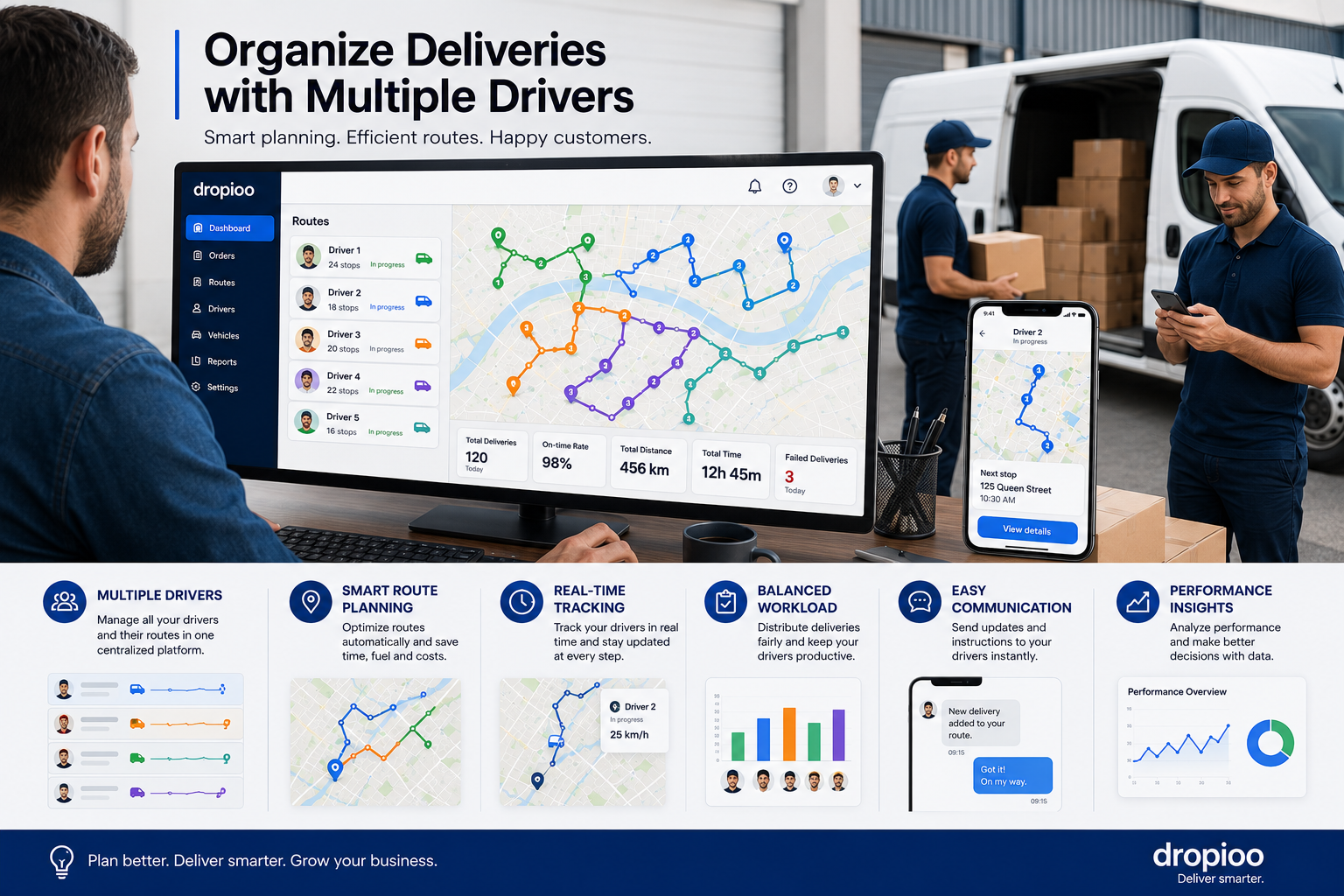
Managing multiple drivers can quickly become challenging as the number of deliveries increases. Learn how to efficiently assign orders, balance workloads, optimize routes, manage driver availability, and improve overall delivery performance.
On this page
How to Organize Deliveries with Multiple Drivers
Managing a few deliveries with a single driver can be relatively simple. However, as the number of orders increases and multiple drivers need to operate simultaneously, delivery management quickly becomes more complex.
Each driver may have a different vehicle, specific working hours, a limited capacity, and particular skills. At the same time, orders may have different addresses, delivery time windows, priorities, and requirements.
Without an effective organization, a company can quickly end up with unbalanced routes, unnecessary mileage, delivery delays, and higher operating costs.
So, how can you effectively organize deliveries with multiple drivers?
1. Centralize All Your Orders
The first step is to have a complete overview of all orders that need to be delivered.
For each order, it is important to know:
The delivery address
Customer contact information
The scheduled delivery date and time
Any delivery time windows
The weight or volume of the goods
Special delivery instructions
The current order status
When this information is scattered across Excel spreadsheets, messages, phone calls, and different systems, the risk of errors increases.
A centralized platform allows operations managers to have a complete overview before planning the routes.
2. Know Each Driver's Availability
Not all drivers are necessarily available at the same time.
Before creating delivery routes, it is therefore important to know:
Working hours
Available days
Driver absences
Break periods
Usual service areas
Specific restrictions or requirements
For example, if one driver is available from 8:00 AM to 4:00 PM while another works from 10:00 AM to 6:00 PM, their routes cannot be planned in exactly the same way.
Driver availability should therefore be integrated directly into the planning process.
3. Consider Vehicle Characteristics
The vehicle assigned to each driver can also have a major impact on delivery planning.
One vehicle may have significantly more loading capacity than another.
It is therefore important to consider:
Vehicle type
Weight capacity
Loading volume
Maximum number of packages
Vehicle restrictions
Available equipment
For example, a large and bulky order may not be suitable for a small delivery vehicle.
Effective planning therefore means assigning the right order to the right vehicle.
4. Divide Orders Intelligently
When several drivers need to handle dozens or hundreds of deliveries, simply distributing orders randomly is not an effective strategy.
The goal should be to create logical and efficient delivery routes.
Several factors can be considered:
Geographic proximity
Delivery time windows
Vehicle capacity
Driver availability
Order priorities
Special delivery requirements
For example, if 30 orders are located within the same geographic area, it may be more efficient to group them into one route rather than distributing them among several drivers who would have to cross the same area multiple times.
5. Balance the Workload
A common mistake is to assign too many orders to some drivers and too few to others.
Suppose a company has four drivers and 100 orders.
A distribution such as:
Driver A: 40 orders
Driver B: 30 orders
Driver C: 20 orders
Driver D: 10 orders
is not necessarily optimal.
However, the number of orders alone does not determine the actual workload.
Forty deliveries concentrated in one geographic area may be easier to complete than 20 deliveries spread across a large territory.
The goal should therefore be to balance routes according to the actual workload, rather than simply the number of orders assigned to each driver.
6. Optimize Each Driver's Route
Once orders have been assigned, each driver needs a logical and efficient route.
The key question is:
Which driver should deliver which order, and in what sequence?
Effective route optimization can help:
Reduce total mileage
Reduce driving time
Avoid unnecessary trips
Respect delivery time windows
Increase the number of deliveries completed
When multiple drivers are involved, route optimization becomes particularly important because a poor decision affecting one driver can impact the performance of the entire fleet.
7. Consider Delivery Time Windows
Some orders must be delivered within a specific time period.
For example:
8:00 AM – 10:00 AM
10:00 AM – 12:00 PM
2:00 PM – 4:00 PM
A route may appear perfectly optimized geographically but become impossible if customer delivery windows are not respected.
The planning system should therefore consider delivery time windows before assigning orders to drivers.
This helps reduce delays and improve on-time delivery performance.
8. Consider Driver Skills
Not every delivery requires the same skills or qualifications.
Some deliveries may require:
Specific certifications
Special training
Particular experience
Specialized equipment
In such cases, the company must ensure that the order is assigned to a qualified driver.
Effective resource management therefore means considering not only driver availability but also their skills and qualifications.
9. Automate Dispatching
When the number of orders is small, a manager may be able to assign deliveries manually.
However, when a company manages dozens or hundreds of orders per day, this approach quickly becomes difficult to maintain.
Automated dispatching can take multiple factors into account simultaneously, including:
Orders
Drivers
Vehicles
Working hours
Vehicle capacity
Driver skills
Service areas
Delivery constraints
Automation can significantly reduce administrative work while limiting human errors.
10. Give Drivers Clear Information
A well-planned route must be easy for drivers to access and understand.
Drivers should be able to see:
Their assigned orders
The sequence of stops
Customer addresses
Customer information
Delivery instructions
Planned delivery times
Priority orders
The clearer the information, the less often drivers need to contact dispatchers for clarification.
This also allows operations managers to focus on situations that genuinely require their attention.
11. Track Deliveries in Real Time
Planning does not stop once drivers leave the warehouse.
Unexpected events can occur, such as:
Traffic congestion
Vehicle breakdowns
Customer absence
Access problems
Address changes
Urgent new orders
Real-time tracking allows managers to see where drivers are and react quickly when circumstances change.
This visibility can also help companies provide customers with more accurate delivery information.
12. Respond to Last-Minute Changes
Delivery operations rarely go exactly according to plan.
An urgent order may be added, a driver may become unavailable, or a vehicle may break down.
An effective delivery management system must therefore be flexible enough to allow orders to be reassigned quickly.
For example, if a driver becomes unavailable, their remaining orders can be redistributed among other available drivers.
The goal is to avoid having to rebuild the entire delivery plan manually every time something changes.
13. Measure Driver Performance
Once deliveries are completed, it is important to analyze the results.
Companies can monitor indicators such as:
Number of deliveries completed
On-time delivery rate
Total mileage
Average service time per stop
Failed delivery rate
Working hours
Fuel consumption
Customer satisfaction
These metrics help identify recurring problems and continuously improve delivery operations.
Common Mistakes to Avoid When Managing Multiple Drivers
Certain mistakes can significantly reduce the efficiency of delivery operations.
❌ Assigning Orders Based Only on Quantity
The number of orders does not always reflect the actual workload.
❌ Ignoring Delivery Time Windows
A geographically optimized route can still fail if customer delivery times are not respected.
❌ Ignoring Vehicle Capacity
A route may contain more goods than the assigned vehicle can safely carry.
❌ Relying Only on Manual Tools
Spreadsheets, phone calls, and messaging applications can quickly become difficult to manage as the number of orders and drivers increases.
❌ Failing to Monitor Routes
Without visibility into ongoing operations, it becomes difficult to react quickly to unexpected situations.
How Can Dropioo Simplify Multi-Driver Delivery Management?
As the number of drivers and orders increases, manual delivery management becomes increasingly complex.
Dropioo helps businesses centralize their delivery operations and coordinate their resources more efficiently.
The platform can help teams manage:
Orders
Drivers
Vehicles
Driver skills
Route planning
Dispatching
Delivery routes
Operational monitoring
The goal is to help operations teams spend less time manually organizing routes and more time managing and improving their delivery operations.
Conclusion
Organizing deliveries with multiple drivers requires much more than simply distributing orders among available drivers.
Companies need to consider customer locations, driver availability, vehicle capacity, delivery time windows, driver skills, order priorities, and traffic conditions.
As the number of orders increases, route planning becomes more complex. This is why businesses can benefit from tools that automate and simplify part of the delivery management process.
Effective organization can help reduce mileage and costs, improve driver productivity, increase on-time delivery rates, and provide a better customer experience.
With a delivery management and route optimization platform such as Dropioo, businesses can gain greater visibility into their operations and create more efficient delivery routes, even when managing multiple drivers simultaneously.
Ready to optimize your routes?
Start your free trial today - 30 days free, no credit card required.
Start free trialKeep reading
Fleet Management: Common Mistakes to Avoid for Better Deliveries
Discover the most common fleet management mistakes and learn how to reduce operating costs, optimize routes, improve driver performance, and make deliveries more efficient.
Everything You Need to Know About Delivery and Shipping
Learn everything you need to know about delivery and shipping, from order processing and route planning to last-mile delivery and real-time tracking. Discover how Dropioo helps businesses optimize logistics, reduce costs, and improve delivery performance.